Showing posts with label News clipping. Show all posts

Sunday, November 04, 2018

Book Review : 2 Filipiniana Books

In the Philippine Star news today, a book review in the column of Elfren S. Cruz mentioned two (2) "Philippine published books that are great readings". A possible worthy addition to our library Filipiniana collection.

EXCERPTS:

I have rediscovered these past few days that long weekends are great for reading books; and, that there are still so many Philippine published books that are great readings. Here are two discoveries on my reading journey during the recent Undas holidays.

LINEAGE, VISION, EMPIRE: Don Francisco “Paquito” Ortigas Jr. by Alfredo Yuson, Reyes Publishing 2018 .

OCCUPATION: 1942-1945 by Benito Legarda Jr., published by Vibal Foundation, 2016.


Read the full article HERE. Thanks PS.

Saturday, November 03, 2018

New OLFU-Sta. Rosa Campus


In the Manila Standard news yesterday, Our Lady of Fatima University - Sta. Rosa Campus will soon rise in Sta. Rosa, Laguna. New opportunities for librarians in 3-5 years time frame in  our Regional Council or area.

Sunday, October 07, 2018

PDI Editorial : Wanted More Public Libraries


EDITORIAL
Wanted: More public libraries
Philippine Daily Inquirer / 05:16 AM October 07, 2018

Excerpts:

A 2017 Readership Survey by the National Book Development Board (NBDB) shows that, contrary to conventional wisdom, an overwhelming majority of Filipinos — 80 percent of adults, 93 percent of children — continue to read nonschool books.

These findings are a resounding validation of the need for more state-subsidized libraries across the country, where ordinary citizens, especially young people, can access books and publications at no cost to them.

Building such centers of learning — and sustaining them as adequately supported, well-furnished and easily accessible community hubs — seems the obvious way to make books more easily and widely available. Reading, after all, is fundamental to functioning well in society. Filipinos are hungry for books, and the more they are able to read (beyond social media), the better for the country.

Click HERE to read the complete PDI editorial. Thanks PDI.


Saturday, October 06, 2018

PDI Article: What Attracts Filipinos to Read?

Ms Neni Sta. Romana Cruz, as NBDB chair shares some info regarding the conduct of the 2017 Readership Survey by the Philippine Statistical Research and Training Institute as against the previous readership survey conducted in 2013, 2017 and 2012 by SWS which were merely a rider suveys conducted "on the kindness of the benefactors and principal originators of the endeavor".

The fulltext of the article is reposted below to aid readers/researchers/librarians in the background information of the latest readership survey. Readers of this site are strongly advised to refer to original article at the PDI website for citation purposes, for new updates and for the comments of the readers (if any) as a result of the publication of this article. Thank you PDI.


THE LEARNING CURVE


By: Neni Sta. Romana Cruz - @inquirerdotnet 
Philippine Daily Inquirer / 05:10 AM October 06, 2018

It is always a matter of curiosity to know how much our country reads, if at all. That it continues to crave books and reading materials despite the general problems of accessibility and affordability is amazing in itself. But we all know that, for any manner of meaningful long-term planning for both the government and the private sector, such information is absolutely necessary.

The National Book Development Board (NBDB), as the government agency mandated to conduct research on the book publishing industry to determine the reading habits and attitudes of Filipinos, commissioned an independent readership survey in 2017.

There have been previous readership surveys in 2003, 2007 and 2012, but these were rider surveys conducted by the Social Weather Stations. For the first time, the agency had an approved budget item that allowed it to run an independent survey, one no longer dependent on the kindness of benefactors and principal originators of the endeavor.

Leonor G. Reyes, the NBDB operations services director who oversaw the survey, highlighted the firsts in this survey, five years hence. This is the very first time the youth population was included as respondents; the survey had 112 questions compared to 70 in the past, and now included in its coverage digital, audio and e-books. There were dedicated questions on the types of  books acquired—second-hand books, brand-new books, e-books—as well as on other subjects, such as reading from different types of gadgets, e-book apps, fanfiction websites.

The NBDB was privileged to work with the Philippine Statistical Research and Training Institute, which had 2,400 survey respondents: 1,200 were 6 to 17 years old (youth); and 1,200 were 18 years old and above (adults). Textbooks were not included, as leisure reading was the focus. Respondents were asked about their reading habits for the period May 2017 to April 2018.  They were from rural and urban areas all over the country, except the Autonomous Region in Muslim Mindanao because of prevailing security conditions then.

In selecting a national representative sample, the Philippines was divided into four geographic divisions—Luzon, Visayas, Mindanao and National Capital Region. A sample of 300 households was selected from each of the groups for a total of 1,200, with each household having two respondents, an adult and a child. Six households from each selected barangay were chosen based on the 2010 Census of Population and Housing.

Dr. Dennis S. Mapa, project consultant  and dean and professor of the UP School of Statistics, presented the main highlights of the survey. What attracts Filipinos to read? In the order of ranking, both the adults (63.14 percent) and the youth (43.29 percent) chose “interesting topics.” For the youth, illustrations or pictures and “words used [that] are familiar or easy to understand” came next.  Television and Facebook are the youth’s main reading sources these days, with word of mouth as a third source. Newspapers and magazines made up a poor fourth source.

Seventy-five percent of the youth and 73 percent of adults are willing to spend only up to P199 for a foreign book, with a comparative number opting for only up to P99. These findings should have a bearing on the current deliberations in the Senate on the removal of the current tax incentives for industries, including the book publishing industry. It is some comfort that, at the first public hearing, Senators Miguel Zubiri and Juan Edgardo Angara categorically said they were not supportive of any taxes on books.

There is a wealth of information in the results that will guide the NBDB as it continues to strive to support book publishing and readership in the country. Its results will bear on the agency’s policies and strategies on capacity-building, content development and book promotion.

With the high interest of the 100-plus members of the audience at last week’s public presentation, I am certain that many researchers will be led to explore with greater focus other areas of literacy.


Neni Sta. Romana Cruz (nenisrcruz@ gmail.com) is chair of the National Book Development Board and a member of the Eggie Apostol Foundation.

Wednesday, October 03, 2018

Rappler article: 2017 Readership Survey

Posted below is the fulltext of the article appearing at the Rappler website about the result of the 2017 Readership survey of the NBDB done with the UP School of Statistics. Reposted here in the tradition of library "news clipping" of important news about a certain topic to aid researchers/readers/librarians on the hot topic of the day. Readers are advised to refer to the original article for any updates or any reader comments posted to this article. Thank you Rappler.


Sofia Tomacruz
Published 8:55 PM, October 01, 2018
Updated 3:30 PM, October 02, 2018

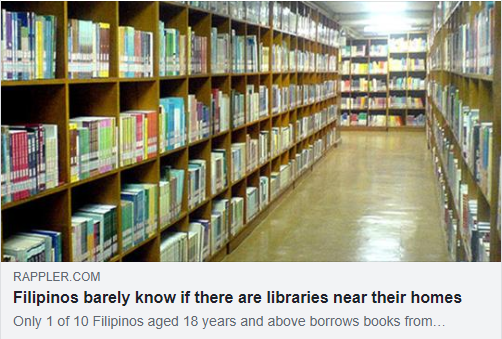
Only 1 of 10 Filipinos aged 18 years and above borrows books from libraries, according to the 2017 National Book Development Board readership survey


MANILA, Philippines – The 2017 National Book Development Board (NBDB) readership survey showed that majority of Filipinos are not aware if there is a library near their residence – only 1 out of 10 does.

The sad truth is you hardly see a library in your barangay (village).

Dr Dennis Mapa, dean of the School of Statistics of University of the Philippines, said only 11% of Filipinos aged 18 years and above borrowed books from libraries. Mapa and his team conducted the readership survey on behalf of the NBDB.

“You have a low level of awareness in particular, so if you borrow a book, for example, where do you borrow it? Baka walang barangay library (maybe there’s no barangay library),” Mapa told Rappler on the sidelines of a forum on the survey’s results Friday, September 28.

Mapa said awareness of libraries was particularly low in the barangay level, with only 12% of respondents answering they knew of the presence of a library in their area.

Meanwhile, less than half of Filipinos in cities and municipalities had no clue. Results showed about 41%, or 2 of 5, were aware if any sort of library was present nearby where they lived.

As a result, majority of Filipinos were more likely to purchase or acquire books by borrowing from families, relatives, or friends. Such was the case for 37.74% of respondents 18 years old and above.

Following this option, Filipinos were more likely to have received books as gifts or by buying it themselves from bookstores.

Why this matters: NBDB Chairperson Flor Sta Romana Cruz said libraries are important in ensuring all Filipinos have access to books. (READ: How community libraries can change lives)

NBDB Chairperson Flor Sta Romana Cruz said libraries are important in ensuring all Filipinos have access to books.

“That (libraries) would answer the question of acessiblity, availability, affordability. If they cannot afford, at least they can go to their barangay-level library,” Cruz told Rappler.

But whether or not access was linked to individual’s awareness or the actual presence of a library would need further research, Cruz and Mapa said.

Data from the National Library of the Philippines showed there were about 1,416 libraries affiliated with the government agency as of 2016.

Meanwhile, Cruz suggested local government units should also consider funding the construction of libraries as social spaces and venues of learning for its residents. 

The NBDB readership survey was conducted from May to June 2018 and covered a total of 2,400 respondents nationwide, except for the Autonomous Region in Muslim Mindanao. – Rappler.com

Sunday, August 13, 2017

News Clipping : 7 things You Should Know About Random Drug Testing in Schools

Source: http://newsinfo.inquirer.net/922442/deped-guidelines-random-drug-testing-in-schools

By: Pathricia Ann V. Roxas - @inquirerdotnetINQUIRER.net / 05:59 PM August 13, 2017

The Department of Education (DepEd) has issued guidelines in conducting random drug testing among students in public and private secondary high schools.

DepEd Order No. 40, posted Aug. 8 on the DepEd website, was based on parameters laid down by the Comprehensive Dangerous Drugs of 2002 (Republic Act No. 9165) and its implementing rules and regulations.

It also adapted Dangerous Drugs Board Regulation No. 6, series of 2003, as amended by Dangerous Drugs Board Regulation No. 3, series of 2009.

Here are the seven most important things you have to know about the order:

The number and location of students to be tested will be based on a stratified cluster sampling of junior and senior high school students. A committee will be created at the DepEd Central Office. The committee will then organize random drug testing teams (RDT teams). The exact date, time and place of testing, and participants will remain confidential among authorities.

A regular or special parent-teachers conference will be conducted to explain the drug testing. Failure by parents or students to attend such meeting will not exclude the student from the possibility of being chosen.

Students selected for the drug testing will be oriented and will be required to accomplish a drug testing form. To safeguard the integrity of the urine sample, the student will be accompanied by a specimen collector of the same gender as the student.

All specimens collected should be transferred to the Department of Health’s (DOH) custody. DOH will issue the results within 15 days. The results should remain confidential, whether negative or positive. Only the parents and the student will be informed of the results by the drug testing coordinator. All positive results must be subject to confirmatory analysis.

For students who test positive, the concerned drug testing coordinator will set a conference with the student, parents and a DOH-accredited physician to discuss issues of drug use and possible dependency.

After the conference, the drug dependency level of the students should be identified. If found to be drug-dependent, the student will be referred to the Department of Social Welfare and Development (DSWD). Or the family may opt to send the student to a private rehabilitation center. Even if parents should refuse to act, the process would still continue.

Positive confirmatory drug test result should not be a ground for expulsion or any disciplinary action against the student and should not be reflected in any and all academic records. The results should also not incriminate any student or be used as evidence in any court or tribunal proceedings.

Schools that refuse to implement the random drug testing program will be reported to the Philippine Drug Enforcement Agency and the Dangerous Drugs Board for appropriate action.

Meanwhile, chosen students who refuse to undergo the random drug testing will be reported to the committee.

Thursday, March 09, 2017

117th Philippine Public Library Day

From the Manila Bulletin

Public Library connects, builds communities
Published March 9, 2017, 10:00 PM

THE nation observed the 117th Public Library Day on March 9, 2017, led by the National Library of the Philippines (NLP).

NLP, the premier public library and repository of Philippine history and culture, is the keeper of printed and recorded cultural, intellectual, and literary materials. Its wide Filipiniana collection, books, bibliographic services, journals, databases, maps, stamps, drawings, and manuscripts are rich sources of information and knowledge for Filipino students and researchers.

There are 1,238 public libraries affiliated with NLP, consisting of one regional public library, four congressional district, 49 provincial, 101 city, 577 municipal, and 506 barangay or community libraries. Sharing of information and materials between NLP and public libraries is through computer link-up eLib. NLP provides public libraries with book allocations.

More public libraries were built with the enactment of Republic Act 7743 on June 17, 1994, mandating the establishment of congressional, city, and municipal libraries and barangay reading centers nationwide.

Public libraries bring NLP services in the regions; bookmobiles or mini-libraries make available books, magazines, and reading matters to barriofolk and rural pupils in remote communities. Books on wheels, forming an integral part of the library system, serves as vital link between local governments and community members, provides access to underprivileged segment of population, facilities various government programs, and stimulates reading habits in rural areas where there are no libraries or reading centers.

Public librarians undergo training and seminar by the NLP to update them in their work and to keep them abreast of latest development in the field of librarianship. The NLP is holding this year as part of Public Library Day a four-day national conference of librarians in Davao City on March 14-17, 2017, with the theme, “The Emerging Libraries: Connect, Collaborate, and Build Strong Communities.”

The country’s first public library was the American Circulating Library (ACL) established in Manila on March 9, 1900. On March 5, 1901, the American Military Governor in the Philippines, through Public Act No. 96, accepted the ACL as a donation of ACL Association to the American Insular Government. Public Law Act No. 1935 consolidated all libraries and created the Philippine Library. In 1916, the Philippine Library, Division of Archives, Patents, Copyrights, and Trademarks of Executive Bureau, and the Law Library of the Philippine Assembly were merged and called Philippine Library and Museum (PLM). Twelve years later, the Philippine Legislature separated the museum from the library; Public Law No. 3477 in 1928 changed the name from PLM to National Library.

Tags: 17th Public Library Day, Manila Bulletin, mb.com.ph, National Library of the Philippines, Public Library connects builds communities